
Research on great black-backed gulls using GPS transmitters
C. Eikenaar, R.C. Fijn H.M. Madden, M. Helberg: A GPS transmitter study in relation to Hollandse Kust West offshore wind farm.
Summary
Ecowende has ambitious mitigation goals regarding the ecological impact of offshore wind farms. In addition, the Ecowende wind farm is being used to investigate how the negative ecological effects of future wind farms can be reduced. One of the knowledge gaps concerning potential impacts on birds, identified during the tender phase, relates to collision risks and avoidance behaviour of great black-backed gulls in wind farms. This knowledge gap exists due to a lack of fundamental understanding of the spatial and foraging ecology of great black-backed gulls in the North Sea.
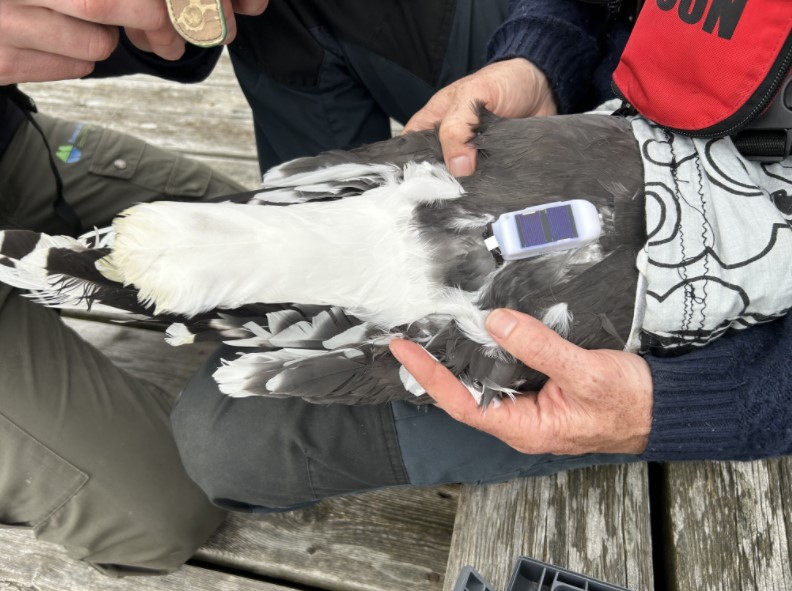
Addressing this knowledge gap through GPS tracking of individual birds is one of the projects within Ecowende’s ecological research programme. The present study covers the first year of this project, in which great black-backed gulls will be monitored over multiple years, both before and after construction of the wind farm.
First results
The GPS transmitters deployed during this first study year are performing very well and are collecting a wealth of spatial data. For example, we were able to identify the most important foraging area of the great black-backed gulls from our study area, information that can be used to help protect this declining species. In contrast to earlier studies, we found no negative effect of the GPS transmitters on breeding success; the number of fledged chicks was the same for birds fitted with a transmitter as for (control) birds without a transmitter. With these promising initial results, we are confident that we can collect reliable long-term data on the distribution, habitat selection, and (foraging) behaviour of great black-backed gulls in the North Sea.